
Why Foreign Investors Are Putting Money Into Georgia
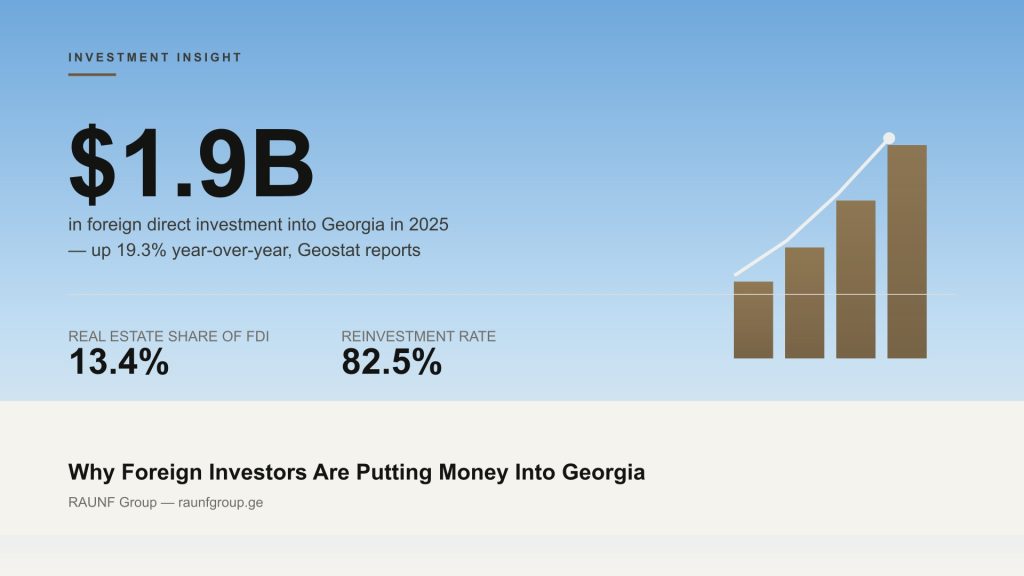
In 2025, foreign direct investment (FDI) into Georgia reached $1.9 billion (precisely $1,900.4 million) — up 19.3% from 2024, according to the latest data from Geostat, the National Statistics Office of Georgia, finalized on August 17, 2026. Who is behind this capital, and why is real estate becoming an increasingly significant part of it?
Where the Capital Is Coming From
According to Geostat’s 2025 data, the three largest sources of investment were:
- United Kingdom — $426.6 million (22.4% of total investment)
- Azerbaijan — $214.4 million (11.3%)
- Turkey — $202.4 million (10.6%)
82.5% of all investment was reinvestment. This shows that a large share of investors already active in the Georgian market continued to increase their investments.
Where the Money Is Actually Going
The financial and insurance sector attracted the largest share of investment (33.3%, or $633.2 million). Real estate came second — $254.7 million, or 13.4% of total investment — followed by trade in third place, at $191.1 million (10.1%).
It’s worth being precise about what that $254.7 million figure actually represents: it’s FDI recorded under the “real estate activities” economic sector, not simply the value of apartments bought directly by foreign individuals. Even so, it confirms real estate is one of Georgia’s core investment sectors, not a peripheral one.
Why Georgia, Specifically
A handful of factors set Georgia apart from neighboring markets:
- Visa-free access with 99 countries
- A liberal foreign-ownership policy — foreigners can buy real estate under the same conditions as Georgian citizens, with the exception of agricultural land
- Property tax under 1%
- An individual who has held residential real estate for more than two years can sell it without paying income tax on the sale gain, subject to the conditions set out in Georgian tax law
- A 1-day property registration process at the Public Registry — genuinely one of the fastest in the world
- A broad network of free trade and preferential trade agreements — including with the EU, EFTA, Turkey, and China — giving access to major regional markets
What This Means for Investors
The numbers point to a clear pattern: Georgia isn’t attracting short-term, speculative capital — it’s attracting investors who stay and reinvest. That kind of environment naturally appeals to real estate investors looking for stability, transparent rules, and real, verifiable growth.
This article is based on Geostat’s 2025 data, finalized August 17, 2026, and international media sources.
© 2026 RAUNF Group. You may quote a passage with a link to this page. Republishing the full text is not permitted.